BeSafe Blog – Blended Learning

Online health and safety training reduces time offsite by up to 1.5 days 

online course Blended learning

By Jason Braithwaite, General Manager BeSafe Training Ltd


Perhaps the labour shortages are giving you a headache because you’re struggling to find the time to spare to send your people to health and safety training. But did you know that blend of digital and vastly reduced classroom learning could save you money and time while keeping your people safer?By Jason Braithwaite, General Manager BeSafe Training Ltd

Most business will be aware of their duties under the Health and Safety at Work Act 2015 to provide information, training, instruction, or supervision to protect all persons from risks within the workplace. Putting this off makes staff vulnerable and puts the business at risk of WorkSafe taking action to make the workplace safe.


Weekend training is not the answer

There isn’t the capacity to send people offsite for long periods at a time. It is now increasingly common for clients to request weekend training, but it is counterproductive when staff have already worked a 40 or 60 hour week. It is also not a good idea because it takes away family and resting time, and people come into the classroom with the wrong attitude because they resent using up their weekends.

Understandably it’s happening because you don’t want to take staff out of operations for two, three or four days as this makes you short-staffed and that, in itself, is hazardous. It’s a rock and a hard place.

Some employers are deferring training they are legally required to do or required to have in place within the terms of their contract. As a result, one company we know of was recently shut down at the cost of tens of thousands of dollars a day for several weeks.

It’s a problem digital learning can help solve, but some employers are resistant.

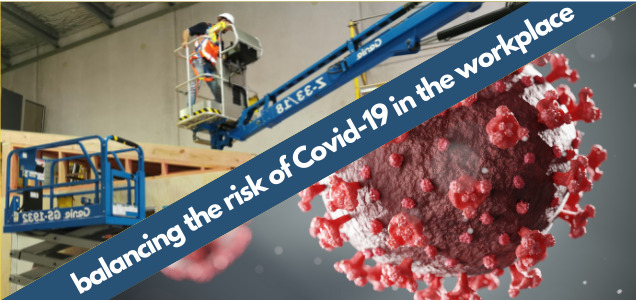
The Covid-19 pandemic lockdown – past and present – is helping overcome the lack of trust some have in digital learning, mainly since a blend of online and classroom can reduce time spent offsite from two days to just four hours.

We understand that many employers have concerns around how effective the health and safety training will be when an employee – some of whom may have literacy challenges – is left to learn independently of a classroom setting.

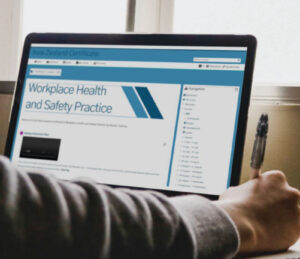
Apart from being better than nothing, digital learning is more effective because learners cannot lean on others in the class. They learn as individuals and are assessed as individuals. There is always a tutor available via email or on the other end of the phone. 

I would urge employers to embrace digital learning for health and safety because it helps keep staff and the business safer and improves productivity and profits.

A blend of digital and classroom learning can be done over time, particularly if an employer schedules an hour a day, on a roster basis, for staff to do digital learning. On rainy days, employees can get online instead of hanging around and still keep their weekends free.

The current Covid-19 lockdown will only add to the time pressure by putting you under the pump, creating more significant staff risks and putting the business in danger of non-compliance.


Keeping your workers safer, (more) aware and productive onsite is a delicate balancing act, but it can be done by taking action on the following steps:”


  1. Conduct a training needs analysis

Do a training needs analysis to identify significant risks and gaps in health and safety training and compliance.


  1. Set aside time and facilities 

All employers need to do is set aside a dedicated space and some computers to get started.

You could have a group of staff sit down together for a toolbox session and group discussion. Put it on the roster. They will have completed the theory component in just an hour or so a day over eight days, and practical offsite training should only take them out for four or so hours.


  1. Appoint an internal person as a support

An internal support person or programme leader, along with your training provider’s tutor, will achieve significantly enhanced learning outcomes compared to onsite classroom learning at a training facility.

The eLearning material is the same as the classroom resource. It is less disruptive, and that will become even more important as the current Covid-19 lock time puts construction companies and manufacturers under increased pressure, particularly as the busiest time of year – the summer season – approaches.

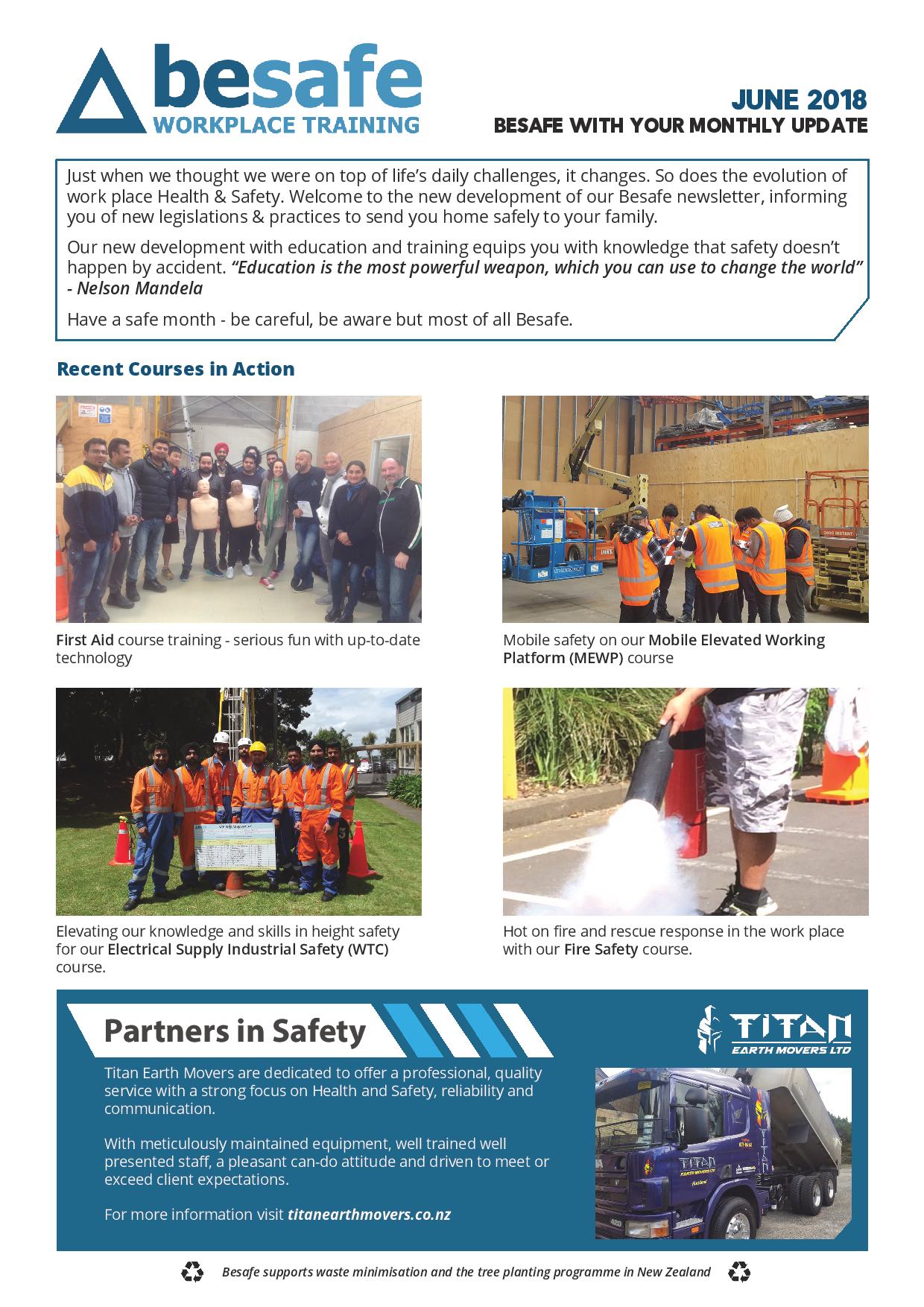
Besafe with your monthly update – June 2018

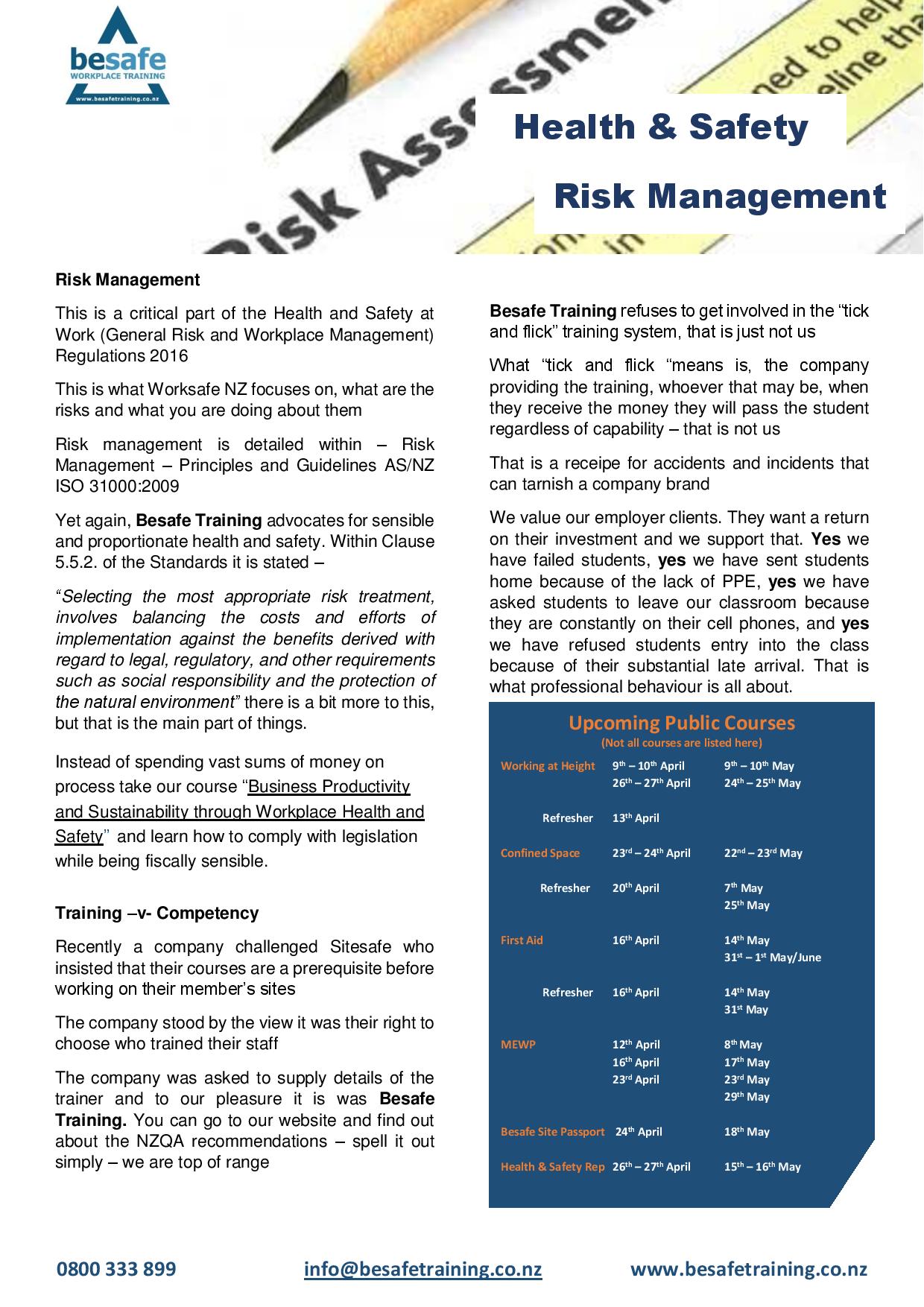
Health and Safety – Risk Management (April 2018)

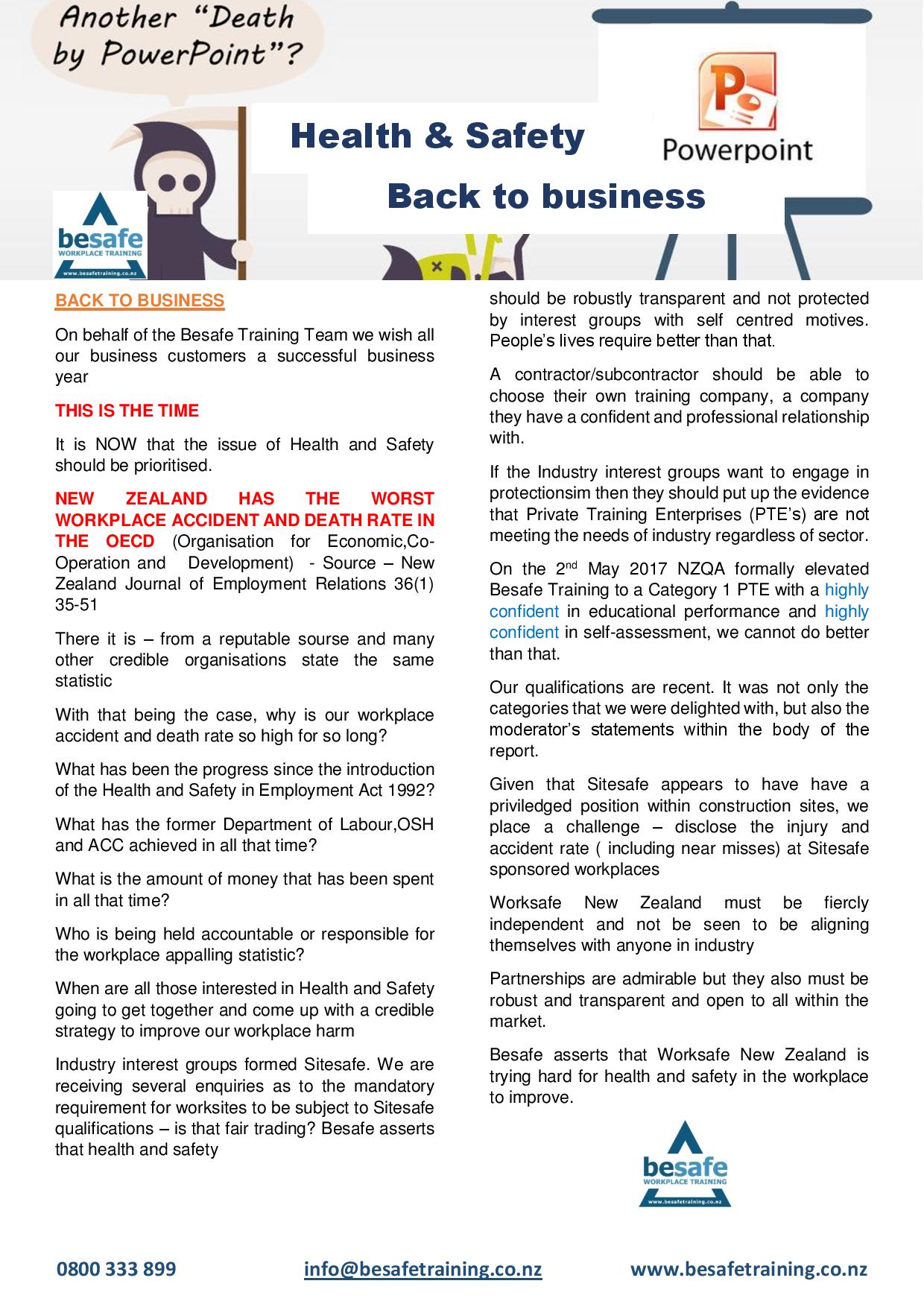
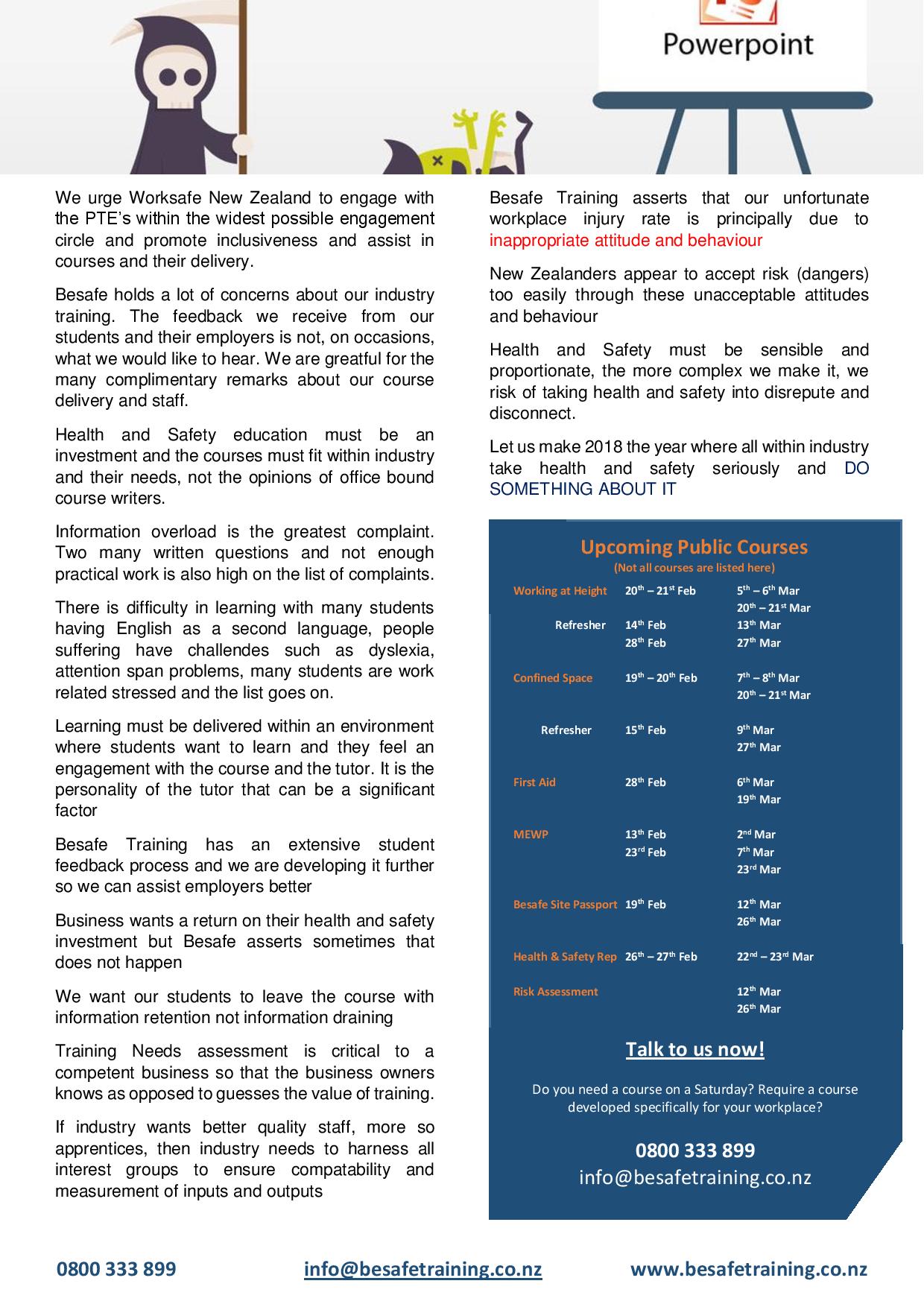
Health and Safety – Back to business (Feb 2018)

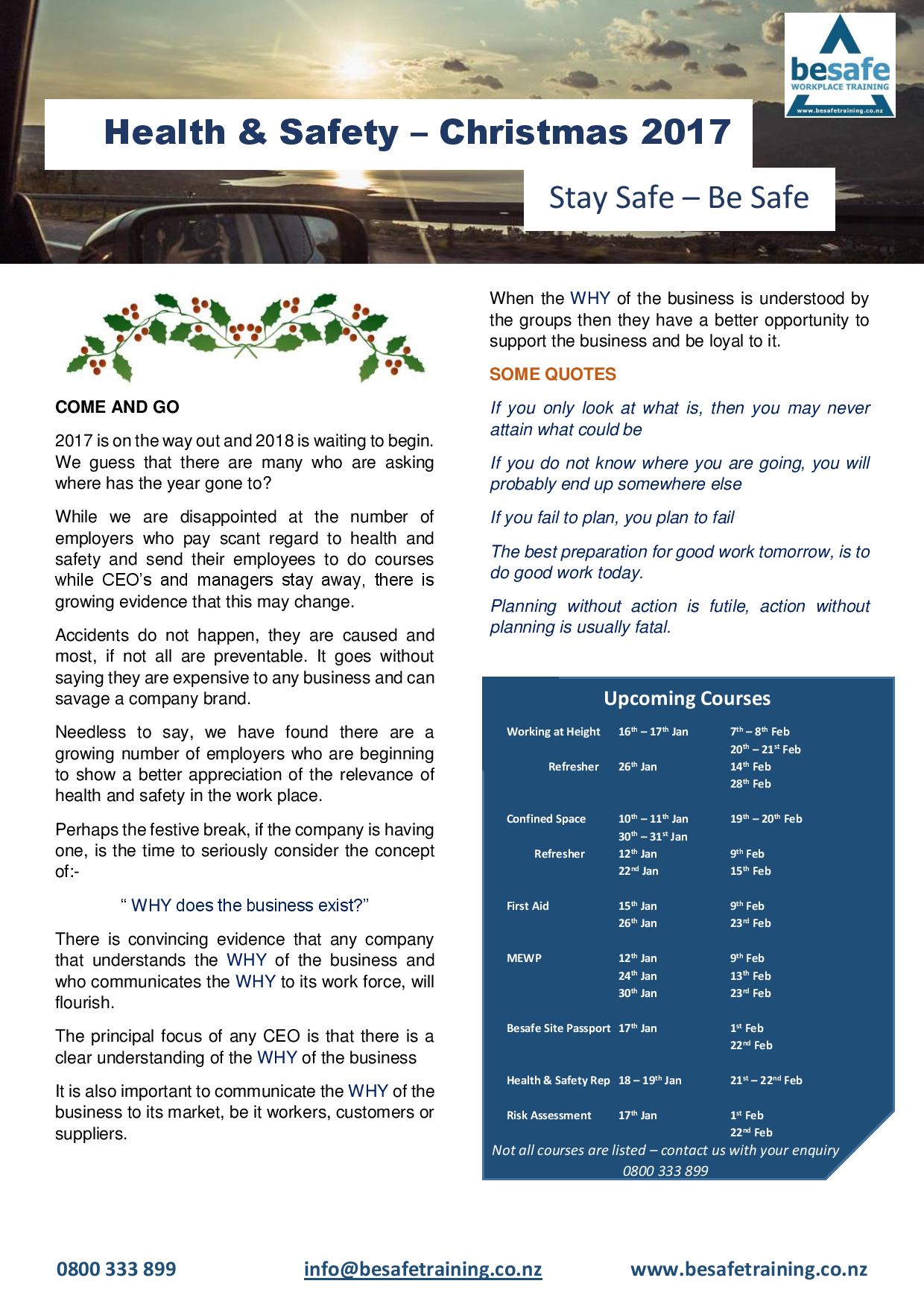
Health & Safety – Stay Safe – Be Safe (Dec 2017)

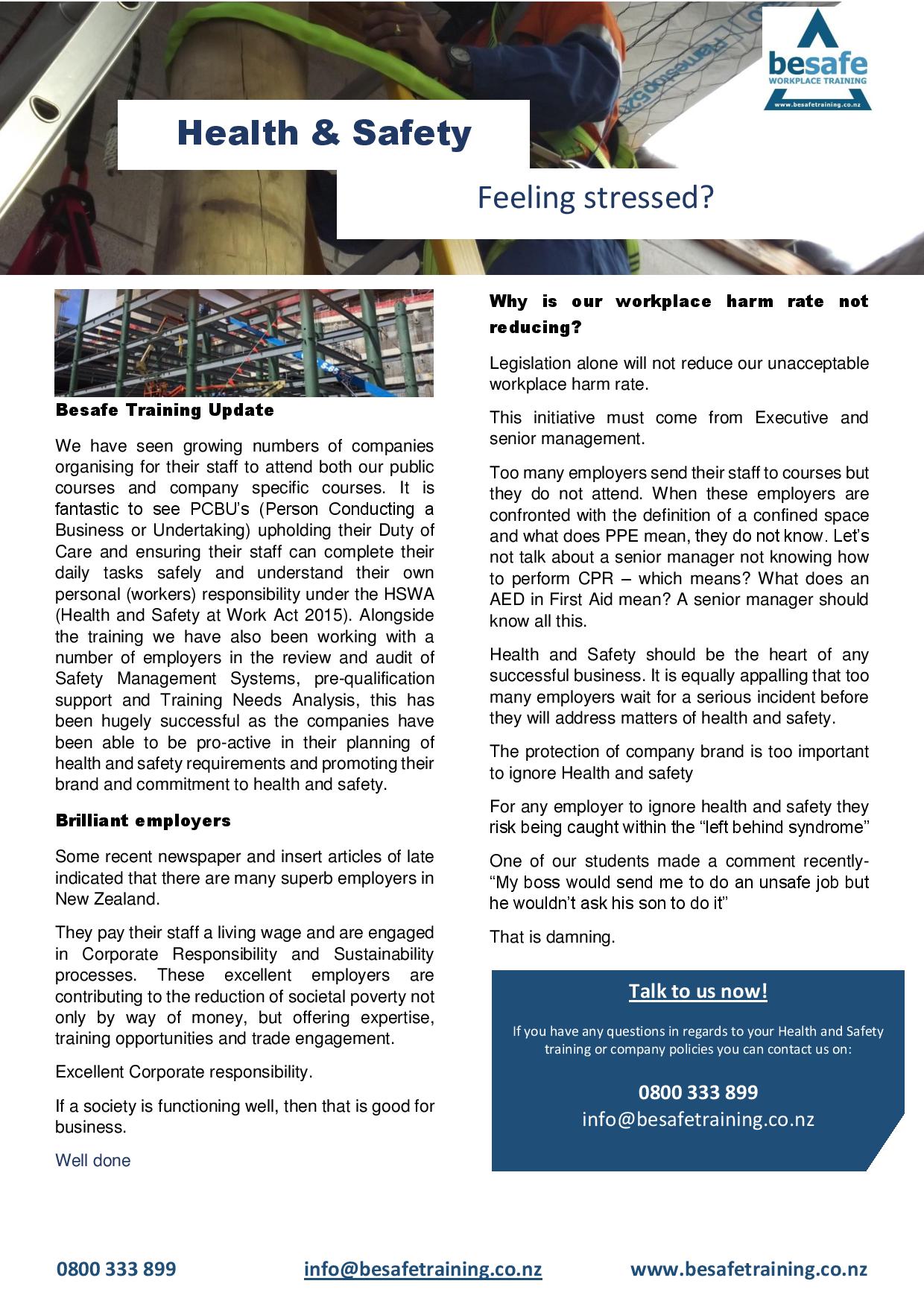
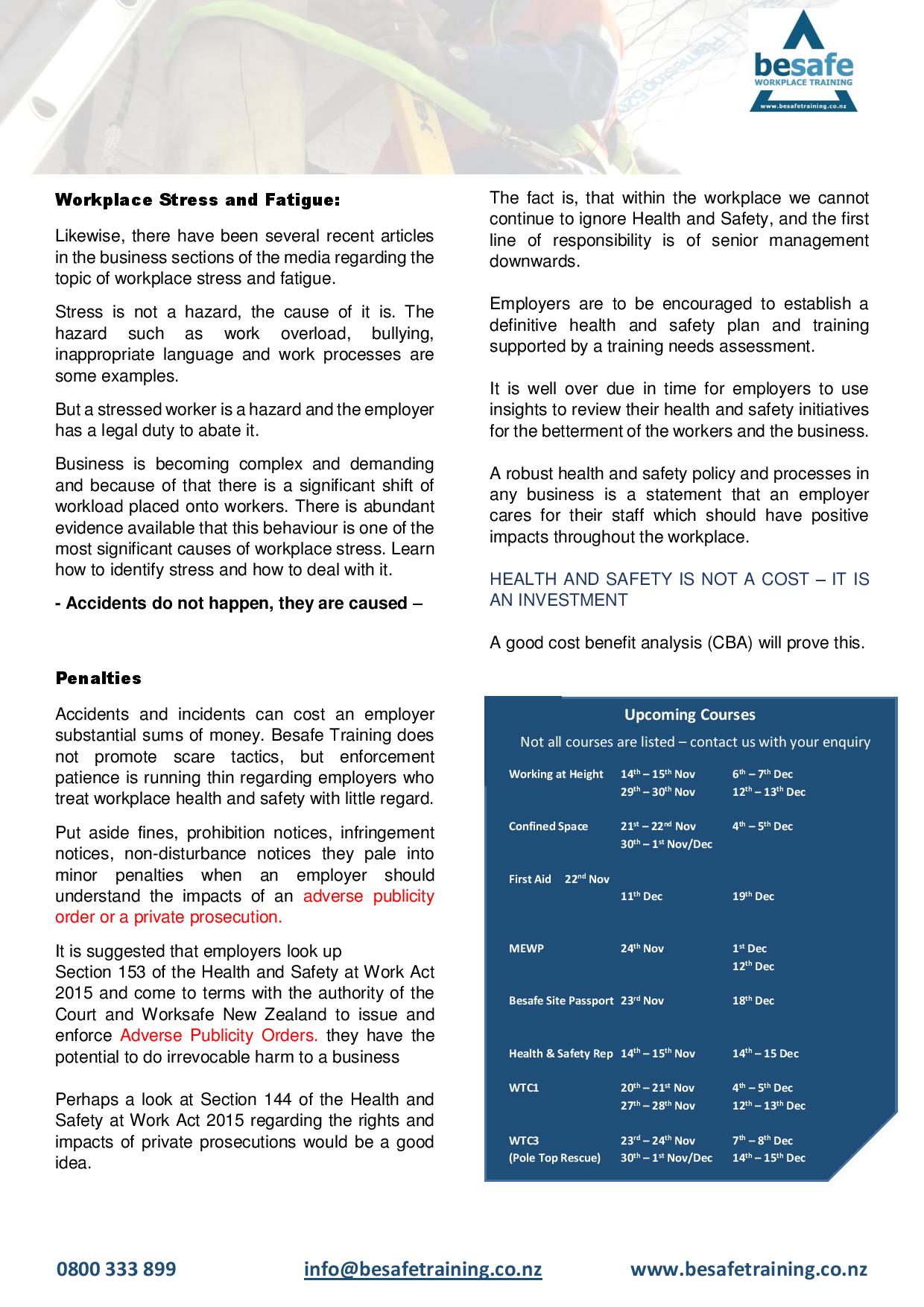
Health and Safety – Feeling Stressed? (Nov 2017)

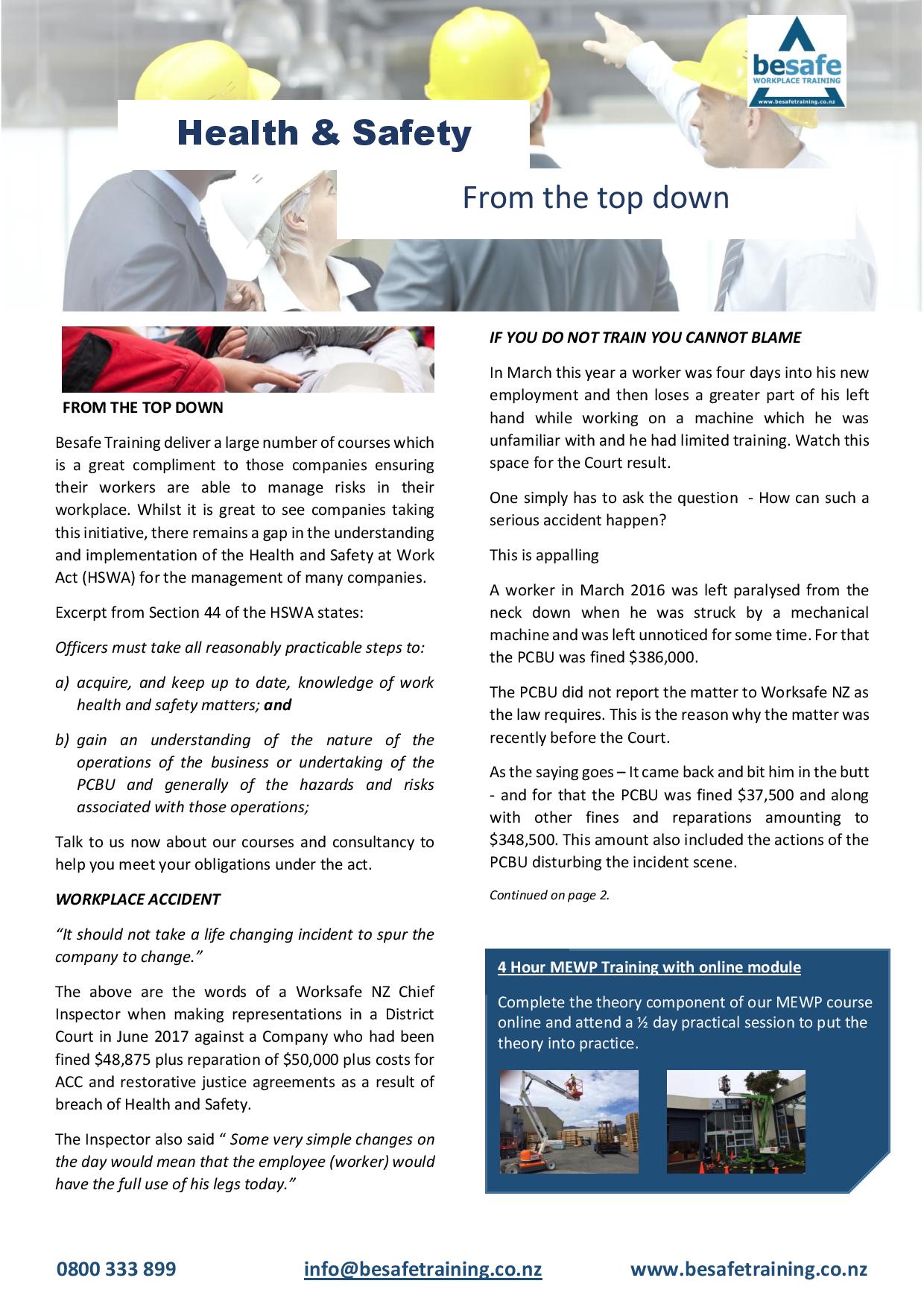
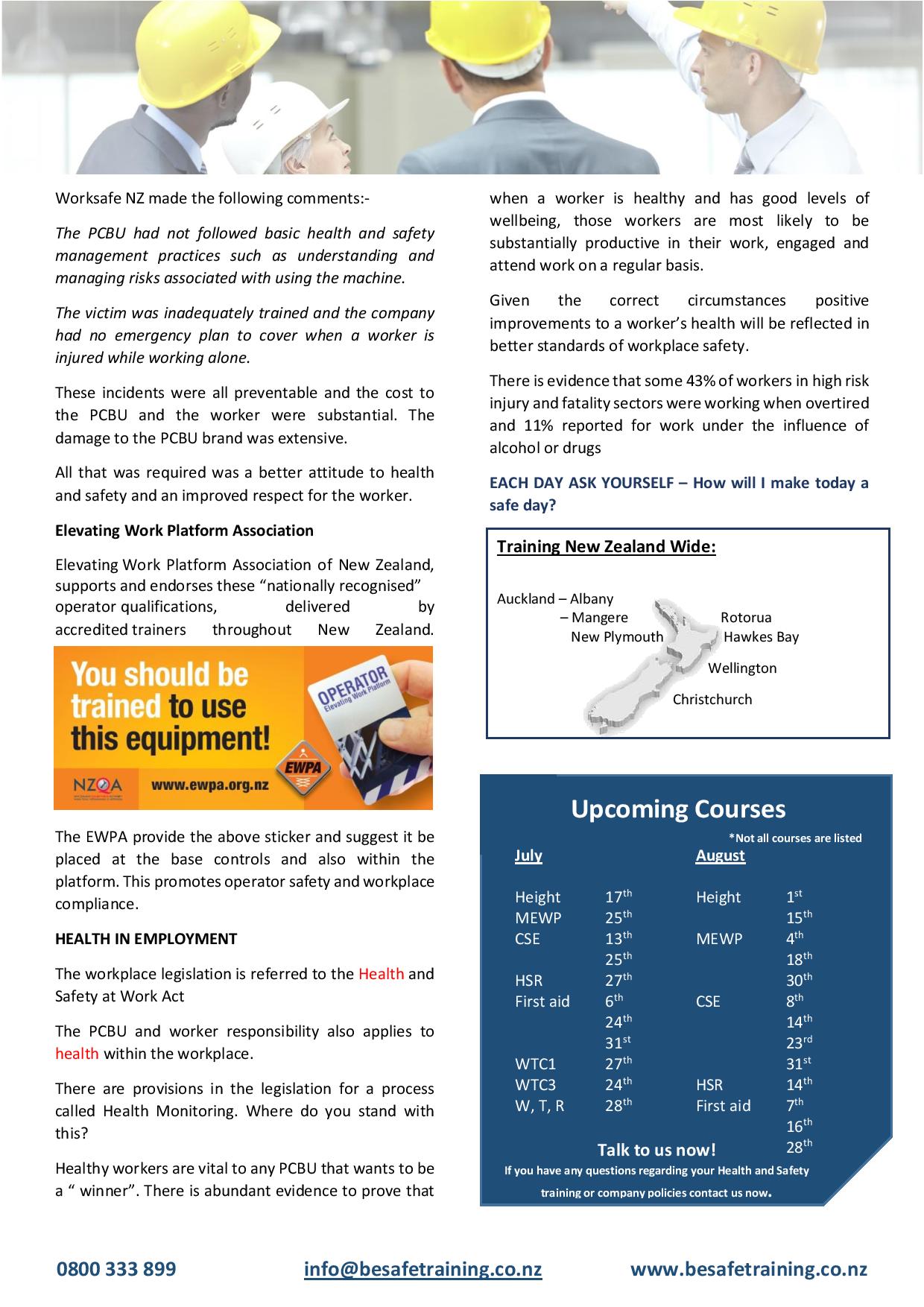
Health & Safety – From the top down (July 2017)

BESAFE NEWSLETTER July 2017-page-001

BESAFE NEWSLETTER July 2017-page-002

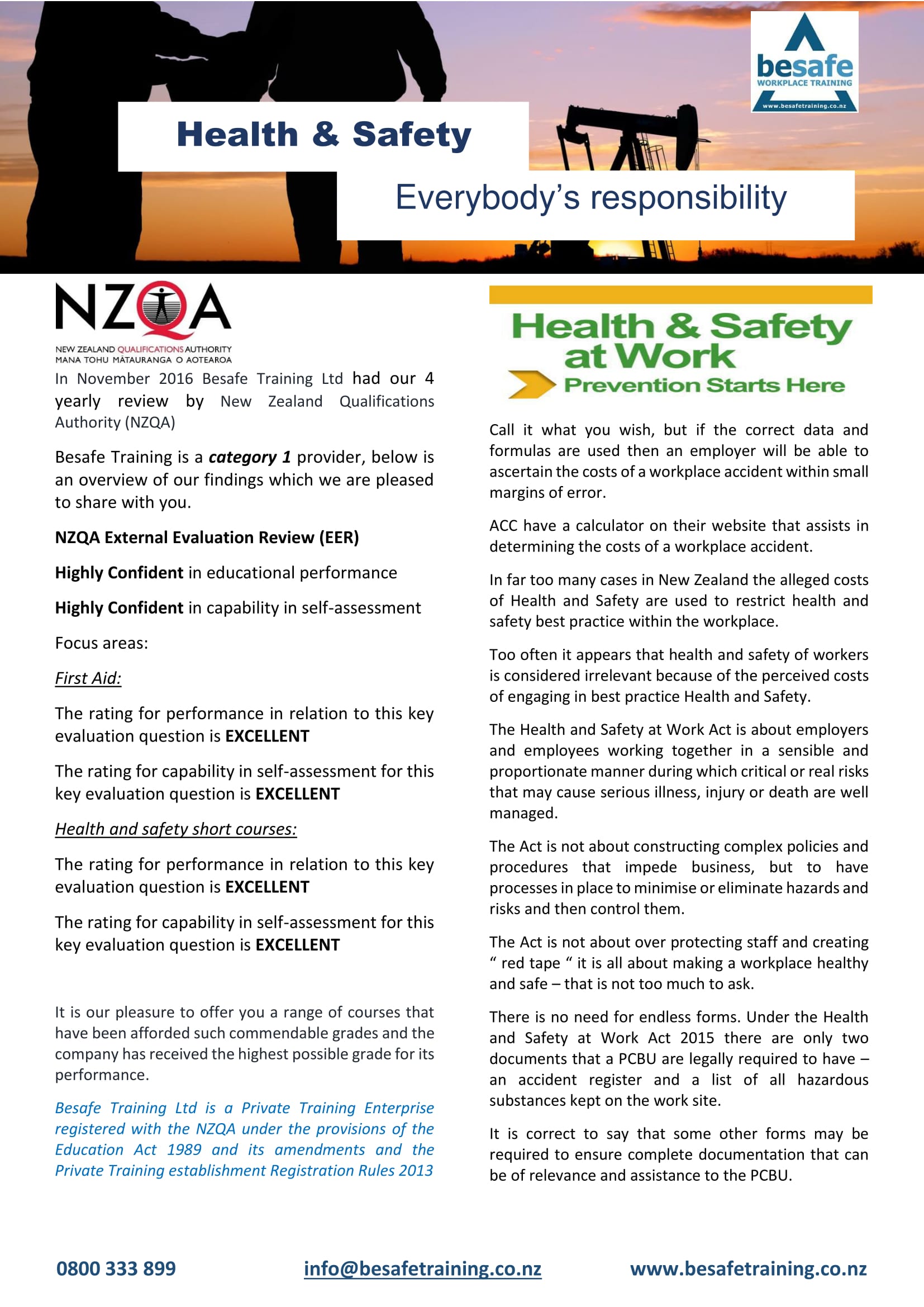
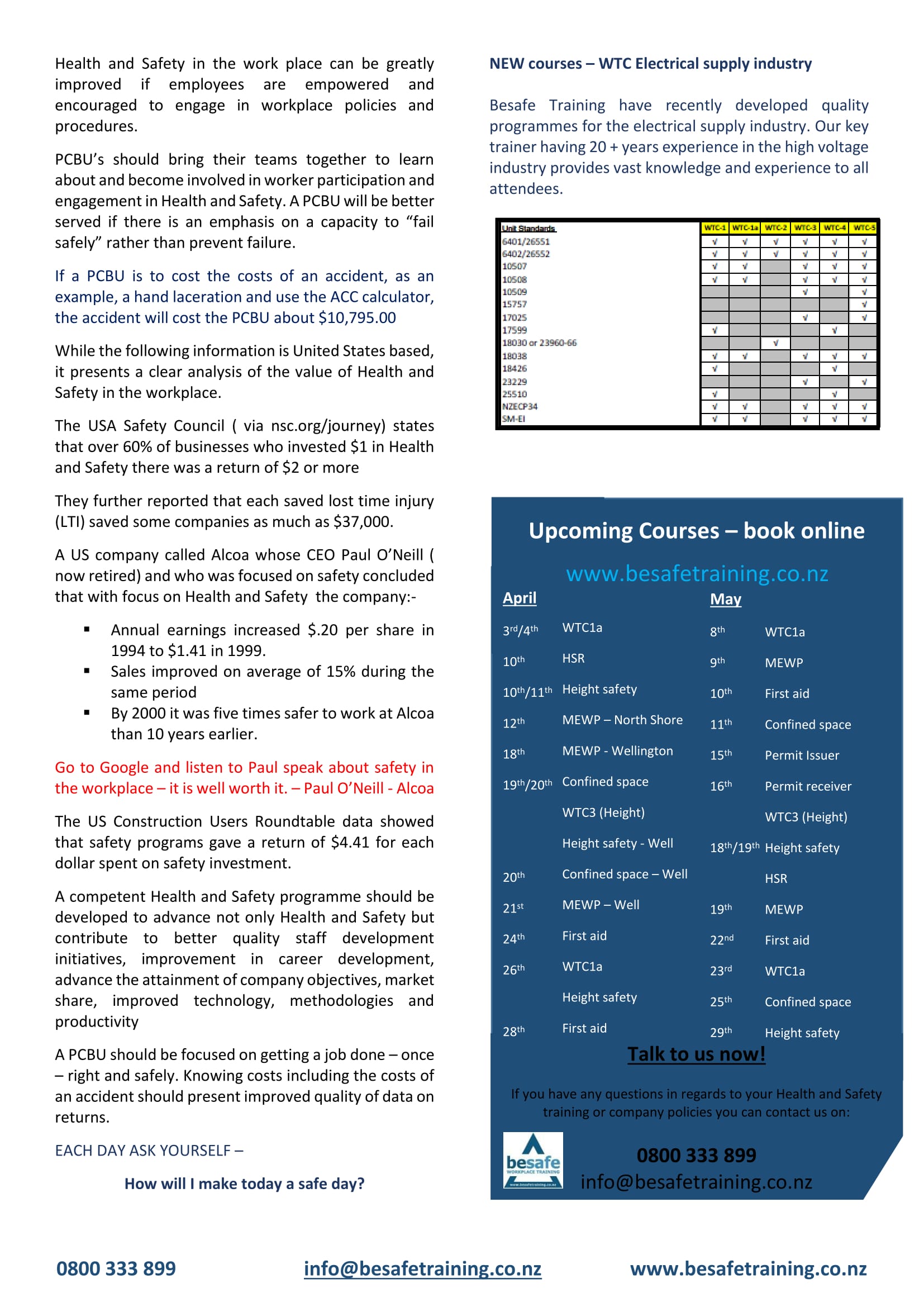
Health & Safety – Everybody’s responsibility (March 2017)

BESAFE NEWSLETTER 2017-1

BESAFE NEWSLETTER 2017-2

Health & Safety – A new year (Jan 2017)

BESAFE NEWSLETTER JAN 2017-1 BESAFE NEWSLETTER JAN 2017-2

Health & Safety – Workplace Attitudes (Sep-Oct 2016)

Health & Safety – changing attitudes (June 2016)

BESAFE NEWSLETTER JUNE2-page-001 (1)

BESAFE NEWSLETTER JUNE2-page-002

Health & Safety at Work (Mar-Apr 2016)

Health & Safety – an investment (Jan-Feb 2016)

SPECIAL BULLETIN FROM BESAFE TRAINING

COWBOYS AND UNSCRUPULOUS PLAYERS IN HEALTH AND SAFETY TRAINING

In the NZ Herald on the 15th January 2016 there was an article about some Health and Safety Training Companies cold calling on businesses with the suggestion that they are needed to keep companies out of jail.

Within the article, some of the Training Companies were labelled as “cowboys” and being unscrupulous by them taking advantage of some confusions relevant to the new Health and Safety at Work legislation.

Besafe Training distances itself from such behaviour and considerations and we proudly say so.

Since September 2015 we have been saying in our newsletters there is no need to panic regarding the new legislation.

We agree that the Health and Safety at Work Act 2015 has its challenges and there are going to be times when there will be periods of unsurety and misunderstanding.

Besafe Training has studied the new legislation and have had a meeting with Worksafe New Zealand. We are satisfied that Worksafe NZ will work collaboratively with business to bed in the new legislation.

It is unfortunate that these “cowboys” are promoting the increased penalties under the Act. It is true they are substantial but Courts must be governed by the principles as detailed in the Sentencing Act 2002. It is rare that Courts impose maximum penalties. Courts will listen to submissions made to it and from there penalties are imposed. It would take a grave and serious offence for maximum penalties to be imposed. History has proven that time and time again.

Besafe Training has been working on an amalgam of training, policies and procedures, employment agreements and consultation to assist business to implement best standards in Health and Safety. As long as business can show it is working conscientiously to improve Health and Safety there will be few enforcement issues.

Where trouble will be, is with employers and employees who treat Health and Safety with little regard.

The emphasis is on taking practical and soon to be reasonable steps to ensure Health and Safety in the workplace causes no harm, Besafe Training can assist in cost effective consultancy to assist business along a Health and Safety roadmap that in law is most acceptable.

Post imported by Google+Blog for WordPress.

Training for the ‘What if’

Think back to the miraculous landing of US Airways Flight 1549 on the Hudson River, New York. Flight Captain Chesley Sullenburger was climbing to cruising altitude when the plane struck a flock of Canadian Gees disabling both engines. Due to thorough training and fast thinking the plane was skillfully ditched onto the Hudson River where all passengers and crew evacuated the aircraft. There were no fatalities. Do you think Chesley started his work day planning to ditch his aircraft? Absolutely not, however every week he would train on a flight simulator for the ‘what if’ (worst case scenario). This was evident in the almost flawless ditching of the aircraft with no fatalities. If you do not train for the ‘What if’ scenarios of your workplace, how will you respond in an emergency situation?  

Post imported by Google+Blog for WordPress.

Are you prepared for the changes with the upcoming release of the Health and Safety…

Are you prepared for the changes with the upcoming release of the Health and Safety at Work Act? Follow the link to see the latest updates and contact us for any support or advice.

Health and safety reform bill | Worksafe
Where is the new law at? The Health and Safety Reform Bill has been passed by Parliament. It will come into effect on 4 April 2016. You can view the new Act here. What happens next? The new law will be called the Health and Safety at Work Act. A series of regulations are being developed to …

Post imported by Google+Blog for WordPress.

Click below to read our recent newsletter

Click below to read our recent newsletter

Embedded Link

www.besafetraining.co.nz/wp-content/uploads/2015/09/Newsletter-2.pdf

Post imported by Google+Blog for WordPress.

The benefit of working in Fall Restraint with well positioned anchor points.

The benefit of working in Fall Restraint with well positioned anchor points.

Post imported by Google+Blog for WordPress.

WINZ charged over Ashburton Shooting

Post imported by Google+Blog for WordPress.

Boss sentenced to home detention – interesting read.

Boss sentenced to home detention – interesting read.

NSCA: Safe-T-Bulletin 416
Boss sentenced to home detention. A New Zealand company director has been sentenced to home detention after sheep and dogs were electrocuted and people were put at risk from live electrical wires. Britton Housemovers Limited was moving a house along Herbertville Road in Herbertville when it …

Post imported by Google+Blog for WordPress.

We currently have spaces left on our Working at Heights training on the 23rd and…

We currently have spaces left on our Working at Heights training on the 23rd and 24th of February, unit standards 23229 & 15757. Click below for more details.

Embedded Link

Working at Heights Training | Besafe Training Ltd
Our Besafe Working at Heights Training course will make sure you are able to correctly use height safety equipment to complete your job in a safe manner.

Post imported by Google+Blog for WordPress.

Have you got a current First Aid Certificate? Talk to us or see our website about…

Have you got a current First Aid Certificate? Talk to us or see our website about our full or refresher courses. www.besafetraining.co.nz

Post imported by Google+Blog for WordPress.

We have updated our website to help make it easier to navigate…come and have a…

We have updated our website to help make it easier to navigate…come and have a look and find the courses you require. www.besafetraining.co.nz

Post imported by Google+Blog for WordPress.


Address: 1B Beatrice Tinsley Crescent, Rosedale, Auckland 0632

+ Google Map

Phone: +64 9 555 2365

Email: info@besafetraining.co.nz

This website has been developed for modern browsers. To view this website please update your browser here browsehappy.com. Thank you.